One of the most expensive mistakes early-stage founders make is building the wrong product. "Not bad code", "not weak design" , but the wrong product. This often results in months of wasted execution, budget burn, and strategic confusion. A common strategic question founders face is whether to build custom software for internal business operations or launch a SaaS MVP intended for the market. Both involve software development, but the business outcomes are fundamentally different. Making the right decision early can save months of wasted execution, budget burn, and strategic confusion.
The Core Difference
The simplest distinction is this.
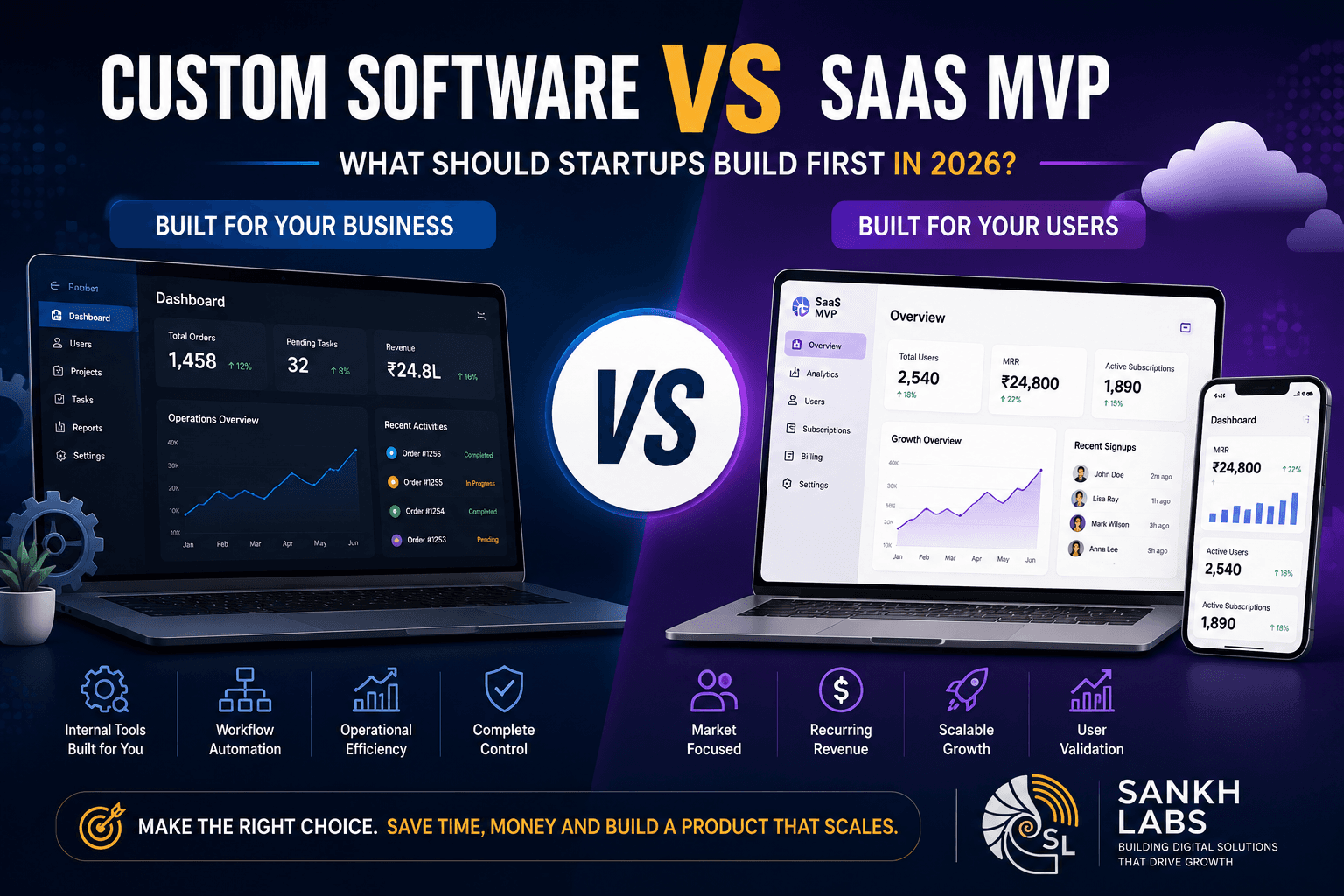
Custom software improves your business.
A SaaS MVP becomes your business.
That difference changes product strategy, execution timelines, hiring decisions, ROI expectations, and long-term architecture.
What Custom Software Actually Means
Custom software is built specifically for internal operational use. It is not intended to be sold as a public product.
Common examples include:
- Internal dashboards
- CRM systems
- Workflow automation tools
- Inventory management systems
- Reporting infrastructure
- Admin management platforms
- Internal operations software
The objective is operational leverage. Better internal systems reduce inefficiency, improve team coordination, and create measurable cost savings.
What a SaaS MVP Actually Means
A SaaS MVP is a market-facing product designed to validate demand. The goal is not internal efficiency. The goal is product validation.
Founders are testing critical questions:
- Will customers pay?
- Is the pain meaningful enough?
- Will users retain?
- Is recurring revenue realistic?
- Can this evolve into a scalable product business?
SaaS MVPs exist to reduce market uncertainty.
The Better Strategic Question
Many founders ask:
What should we build?
That is the wrong starting point.
The better question is:
What business problem are we solving?
If internal operations are the constraint, custom software may be right. If the objective is launching a product company, SaaS MVP is the more logical route.
When Custom Software Makes More Sense
Custom software becomes strategically valuable when execution bottlenecks exist inside the business.
Examples include:
- Sales workflows trapped in spreadsheets
- Operations managed through WhatsApp chaos
- Manual reporting consuming hours weekly
- Multiple disconnected tools
- Slow repetitive internal workflows
In these situations, software improves operational efficiency rather than generating product revenue.
When SaaS MVP Makes More Sense
SaaS MVP makes sense when speed of market validation matters.
Common indicators:
- You have identified recurring market pain
- Users may pay for the solution
- Recurring software revenue is the objective
- Product validation matters more than perfection
- Speed of learning is strategically important
Many founders fail because they attempt to launch version ten first. MVP strategy is about reducing uncertainty, not increasing engineering scope.
Cost Comparison in Practical Terms
Budget comparisons are context-dependent, but broad ranges are useful.Smaller internal software tools may require significantly less investment than advanced operational platforms. SaaS MVPs can begin lean, but complexity rises quickly when billing, onboarding, permissions, analytics, and scalable infrastructure enter scope. Cost alone should never decide product strategy. ROI logic matters more. Custom software typically creates internal efficiency gains. SaaS MVPs target external recurring revenue.
Timeline Expectations
Custom software often ships faster because internal products usually involve narrower workflows.
SaaS MVPs generally require broader system thinking:
- User onboarding
- Authentication
- Subscriptions
- Billing systems
- Admin controls
- Product UX
- Analytics
- Scalability planning
What appears simple from outside often becomes significantly more complex during execution.
Final Perspective
Technology decisions should follow business intent. Not hype-driven choices, temporary market trends, or assumptions made without strategic clarity. If your priority is internal operational leverage, custom software may be the right first investment. If your goal is launching a software business, a disciplined SaaS MVP is the smarter strategic starting point. The right first decision can save enormous time, capital, and product waste.